

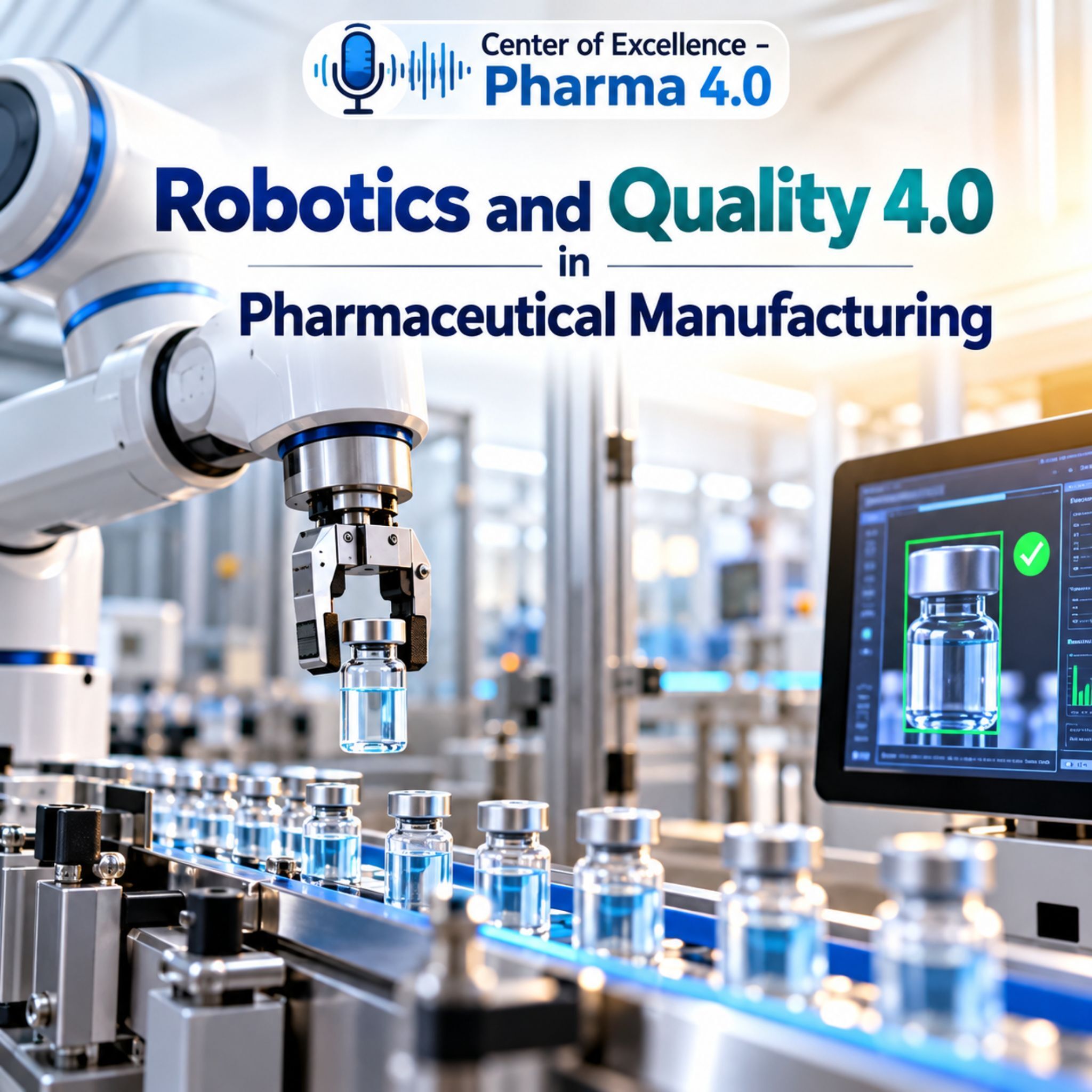

397: Robotics and Quality 4.0 in Pharmaceutical Manufacturing
Robotics and Quality 4.0 in Pharmaceutical Manufacturing
What if pharmaceutical manufacturing could become smarter, safer, and more resilient through intelligent robots, artificial intelligence, and autonomous operations?
In this episode of Center of Excellence – Pharma 4.0, we explore how robotics and Quality 4.0 are transforming pharmaceutical manufacturing, moving the industry beyond conventional automation toward interconnected, AI-driven operations that can monitor processes, anticipate disruptions, and make decisions within validated quality and regulatory boundaries.
The pharmaceutical industry faces mounting pressures from rising production costs, accelerating innovation, stringent regulatory requirements, and shortages of specialized talent. At the same time, even minor variations in manufacturing conditions or human execution can compromise product quality and result in significant financial losses. These challenges are driving pharmaceutical companies to rethink how medicines are manufactured, inspected, and delivered.
What You Will Discover in This Episode
- Robotics and Quality 4.0: How advanced robotics, digital quality systems, and AI can improve consistency, reduce process variability, and support a zero-defect quality mindset.
- AI-powered visual inspection: How computer vision and machine learning can identify vial defects, glass micro-fractures, and foreign particles at high speeds, supporting more consistent quality control.
- From automation to autonomous operations: Why conventional automation, which follows predefined instructions, differs from intelligent systems that use real-time data and AI to adapt operations across the pharmaceutical value chain.
- Digital twins in pharmaceutical manufacturing: How virtual factory models can simulate manufacturing conditions, evaluate process parameters, and help optimize operations before changes are implemented in the physical environment.
- Enterprise-wide robotic applications: How robotics is extending beyond production lines into research and development laboratories, quality control, sampling, warehousing, and logistics.
- Human–robot collaboration: Why the transformation is not simply about eliminating human involvement, but about shifting employees from repetitive manual activities toward system oversight, data analysis, quality decision-making, and strategic responsibilities.
- Regulatory compliance and validated AI: Why autonomous decision-making must remain within established and validated parameters, supported by reliable data and evidence of product quality and safety.
- Supply chain resilience and sustainability: How interconnected systems can anticipate disruptions, adjust operational plans, optimize resource utilization, and reduce waste.
- The strategic role of pharmaceutical leadership: Why robotics has become a boardroom priority, influencing operational efficiency, risk management, sustainable growth, and long-term competitiveness.
From the Factory Floor to the Boardroom
A key theme of this episode is the evolution from isolated robotic tasks to an interconnected pharmaceutical enterprise. When production, quality, laboratories, and logistics systems share information, manufacturers can move toward more proactive and coordinated operations rather than relying exclusively on manual intervention and retrospective analysis.
The discussion also examines the importance of balancing speed with patient safety. Intelligent manufacturing systems must deliver efficiency without compromising validated processes, regulatory compliance, or product quality.
Looking Ahead: Personalized Medicine at Scale
The episode concludes by exploring an intriguing possibility: could increasingly flexible robotic systems and AI eventually make personalized medicine at scale more practical? As manufacturing becomes more adaptive and precise, the potential to produce therapies tailored to individual biological needs raises important questions about the future of pharmaceutical production.
Who should listen?
This episode is particularly relevant for pharmaceutical executives, manufacturing and operations leaders, quality assurance and quality control professionals, automation engineers, digital transformation leaders, regulatory affairs specialists, supply chain professionals, and anyone interested in the future of Pharma 4.0.
Join us as we explore how robotics and Quality 4.0 can help shape a pharmaceutical industry that is more intelligent, consistent, agile, and patient-focused.
Resources:
Book Series: Center of Excellence – Pharma 4.0 https://www.amazon.com/dp/B0F1DX4XXB
Book Series: Cybersecurity for Pharma 4.0 https://www.amazon.com/dp/B0HFW5988N
Podcast: https://pharma4coe.podbean.com
YouTube Channel: https://www.youtube.com/@COE-PHARMA4.0
Udemy Course: Smart Manufacturing in Pharma https://www.udemy.com/course/smart-manufacturing-in-pharma/
Website: https://respa.com
#Pharma40 #Quality40 #PharmaceuticalManufacturing #PharmaRobotics #ArtificialIntelligence #AIinPharma #SmartManufacturing #DigitalTransformation #PharmaceuticalQuality #QualityAssurance #QualityControl #ComputerVision #DigitalTwins #AutonomousManufacturing #PharmaInnovation #Industry40 #PharmaTechnology #SupplyChainResilience #RegulatoryCompliance #PersonalizedMedicine